Saturday, January 22, 2011

St. Louis Missouri: Stephen Inman, New Roots Urban Farm

It was a sultry, humid evening in St. Louis when we arrived at the urban farm project maintained by Stephen and a core group of a few other volunteers.  The farm is planted on a postage stamp lot and has a greenhouse, chicken coop, and picnic table toward the rear.

"I'm more prone to calling it a garden this year.  Before it was like, "don't call it a garden!  It's a farm!"

We sat at the picnic table and watched the sun set on the abundant crops while Stephen told us about the challenges and perks of being an urban farmer.  This garden has been functioning for about seven years and Stephen told us the story of the four individuals who got New Roots going.  Everybody is a volunteer and they have initiated or helped with several other food and social justice projects in St. Louis.  The produce that is harvested supplies an impressive number of CSA boxes for its size and it barely pays for the next season of the garden's existence.

It is difficult to operate not knowing if the yield will bring in enough money for another season of planting and harvesting, but that is the reality of most farms, rural or urban.  One of Stephen's goals is to have this garden produce enough to pay for a gardener who will lead the project and volunteers, since that position doesn't exist right now and the garden is run on hopeful volunteer labor and luck.  The volunteers do get to walk away with some of the food, but the whole project started when the founders realized that they couldn't afford their own produce on their rural farm outside the city.  A garden that won't sustain the folks who work it seems doomed to failure, or, at the very least, ironic.

Despite the typical volunteer and practical urban issues, the kale is looking lovely, and as we sit chatting with Stephen a few neighborhood folks wander in to check on the crops and do some harvesting, thankful for this abundant gift of food amidst the hustle and bustle of the city.  We watch the sun set and the city sky turn purple over the distant skyscrapers and abandoned brick neighborhood buildings...

Click here for Stephen's story in his own words...

Thursday, January 13, 2011

Council Grove, Kansas: Don and Doris Cress

On a hot Sunday morning, after sleeping at the Canning Creek Cove campground in Kansas, we pulled into the small town of Council Grove.  The town, located roughly between Salina and Topeka, is historically significant for being a key stop on the Santa Fe Trail.  As such, we were not surprised to find ourselves having breakfast at The Santa Fe Cafe, eating a remarkable breakfast burrito.

The Santa Fe Cafe had just changed hands and a family of four was there to greet us and take our order.  Our waitress looked to be about 9 years old and when we ordered 2 breakfast burritos she scrunched her forehead in thought and put her pencil to the order pad and scratched out "2 brayfast blotos" then happily skipped back to the kitchen where her dad was waiting and whispered loudly "Two breakfast burritos dad. But I didn't know how to spell that."

The burritos, or blotos as we now call them, arrived and they could have fed an army with as much eggs and vegetables as were stuffed into that fragile tortilla.  She came back to get our empty plates, offered each of us a raspberry candy and then went outside to hail in the passing motorcyclists that were roaring through downtown slowly on a Sunday morning drive.  There were swarms of motorcyclists out to take advantage of this beautiful bluebird day, and, as we left, a few came in and took our place to order their own blotos.

Trav and I decided that our next course of action would be to go to church, as we figured those Kansans who weren't riding around on their motorcycles would most likely be in a church on Sunday morning, and we wanted to meet people.  I called my dad, who is a minister, to consult and see which denomination would be most likely to have the best snacks and we ended up going with the Presbityrians.

There was a great time of singing and then we sat through an interesting service in which a woman told of her recent experience with a missionary school in Guatemala.  A youth group rafting trip that had been planned for the day before had been cancelled, so as we filed out of the sanctuary we grazed on all the Subway sandwiches that would otherwise be doomed to perish, as well as some excess cucumbers from a parishoners garden.  Between bites we introduced ourselves to the minister and got to telling him about our project with farmers.  With a light in his eye he snapped out his cell phone and called two church members who had just retired from their farm and moved into town, being 91 and 87 years old.

Don and Doris Cress are the oldest farmers that we had the pleasure of interviewing, and their stories about how things used to be were a pleasure, a history and a warning all at the same time.

Click "read more" to see what they had to say in their own words.

Sunday, January 9, 2011

A Thank-You Letter to everybody even slightly involved with this project.

 Many apologies for the vast delays in our blog updates!  We still have many farmers to write about, from Kansas to Oregon, and from Monsanto to Farm-To-School folks.  Kacy and I have both been doing plenty of writing, but neither of us are efficient at transcribing it into the internet yet.  We'll improve!
Just before Christmas we spent some days writing thank-you notes and hand-addressing envelopes to every farmer we interviewed, as well as most of the people we stayed with and the individuals who connected us with farmers along the way.  I'm sorry if some of you whom were key in the project have not received yours; we actually ran out of the postcard I created, which is pictured above.  

Each envelope included this postcard with a personal note on the back, a copy of the individual's portrait when appropriate, and a one-page letter drafted by Kacy, which is shown below.  I took the rather large stack of letters to the post office on December 23rd; I thought, "well, I've organized them by state, to help out the postal workers during this holiday rush."  Feeling like a good samaritan I presented the box to the woman at the counter, and she said in a definitive southern drawl, "Aw, that's sweet of ya, darlin'...but they all get dumped in the bin anyway."  And with a "whoosh!", my carefully organized pile joined the glittering mass of holiday cards and packages, bound for points across the world.

Thanks to everyone involved in the project!  Please read the letter below for an update on our process.

New years resolution: post on this blog at least once a week.


                                                                  Stewards: Stories and Perspectives on American Agriculture
                                                                                                Trav Williams and Kacy Spooner
Winter greetings!

We hope that this note finds you well and warm as December settles over your farms and towns.  Some of you are good old friends and others are people whom we met only briefly for an interview this past season.  This is a hearty Thank You! for being a part of our project; it’s also an update of our progress.

We traveled across the US this past spring and summer, interviewing farmers, ranchers, and other agriculturalists; our intent was to collect a diversity of views, perspectives, and creeds and to publish these conversations as an archive of modern agricultural thought.
In the end, we spoke with over 160 farmers, ranchers, scientists, homesteaders, veterinarians, viticulturalists, historians, seed-savers, editors, and agents.  We traveled for about 6 months on 12,500 miles of gravel and asphalt, seeking out characters and farmers of all types; we ended up with over 350 hours of recorded conversation, from Maine to California.
The youngest farmers were working on their 4-H projects in Illinois and studying sustainable agriculture in Maine.  The oldest were selling their farm in Kansas at the age of 94 or were documenting their own heritage in California.  Some farmers had made their fortunes; others were losing their property or struggling to get started.  Farm sizes ranged from tens of thousands of acres of rangeland in eastern Colorado to ¼ acre lots in St. Louis and Denver.  Some farmers stressed localized and diversified operations, while many others focused on a single crop that was distributed worldwide, such as soybeans.  The diversity within our larger agricultural community is amazing to us.
When we asked the question, “What should the role of the farmer be in our society?” a large number of people included the idea of “stewardship” in their answers.  The working title of this project was “Portrait of a Farm,” but we are now leaning towards the title, “Stewards: Stories and Perspectives on American Agriculture”.

This winter we are working on obtaining further funding that will allow more interviews to take place and allow for a more complete project.  We are transcribing those many hours of recorded conversation and pursuing potential publishers; we’ve begun proposing a book concept, but we will not likely have made publishing decisions before next summer.
You have helped us by either telling us your story, sharing your resources and connections with us, or providing a place to cook food or rest our heads during this trip.  It has been our honor to collect your unique perspectives; we hope that they will touch and educate those who read them.

Besides the interviewees themselves, we’d also like to thank the folks who helped us find farmers; Cooperative Extension and Farm Bureau agents were particularly helpful, connecting us with numerous people and organizations.  We could not have been nearly as thorough without your help. 

At the conclusion of our trip, we decided to settle in western North Carolina for the time being.  We are thankful to be in such a beautiful place.  Travis is working with photography in Asheville and Kacy is working on farmland preservation with the Agricultural Economic Development Office in Polk County.  We are happy and we’re counting on spending lots of time this winter working on this project and musing about the past and the future of American agriculture.
There’s a good chance that, in the next few years, you may find us settled on the farm Trav grew up on in Oregon, but we shall see.  The soil there is fertile and the history is strong.  We will continue to keep you updated about any significant progress on this project, but if you have any questions in the meantime, or if you’d like to continue to have a dialogue, please feel free to contact us anytime.

Within a day or two of today, dozens of farmers and families across the US are opening this same letter as winter approaches.  Whether you are snowed in up in Maine, prepping soil in California, or watching your apple trees turn inward for the winter, know that you are a significant part of a complex and necessary system that keeps us all going.  We hope that all of you and your families are well, that your crops did well, and that next season will be lucrative and satisfying. 

Thanks for telling your story--                                     --Kacy Spooner and Travis Williams

Sunday, December 26, 2010

Berger, Missouri: Wayne and Joy Carl

In rural Missouri, The Carls were sitting on Joy's John Deere mule when we approached them. Joy Carl is 79 and Wayne's uncle.  Wayne is Joy's right hand man on the farm. Joy showed us pictures of the county geography from an old atlas that was falling apart in his hands; he pointed out his farm and how the flooding and droughts over the years have changed the topography. In Missouri people often talk about "The Bottomlands" as an ideal area to farm, though much of it has been developed into towns and lots. 

He has also seen a lot of his contemporaries drop out of farming due to floods and development, but Joy can't think of anything they'd rather be doing than farming. One thing Joy is sensitive about is the negative media attention farmers have been receiving lately. There are a few bad apples out there, but according to these men it is rare to find a farmer who would mistreat his or her animals. Joy thinks that most farmers treat their livestock with more consideration than they'd treat some people with, but that's not what society at large sees.

Berger is a town that is no longer a town; Joy reflected on the days of his youth when it has all the amenities...banks, stores, cafes...but as we left and asked which direction to town, they replied, "that way...but you won't notice."

Tuesday, December 14, 2010

Union, Missouri: Richard Schmidt

Coming into St. Louis was a huge change from rural Illinois; luckily we had a place to stay with Carrie, my mother's best friend in the world. She offered us refuge from the unrelenting heat of July in the city.  She also offered us pizza and the name of a farmer friend of hers, Richard Schmidt.

Richard and family are about 15 miles outside of St. Louis in a wealthy looking subdivision. He raises and sells beef now, but got started with food in a culinary setting. Richard is a former chef and restaurant owner who wanted to move away from urbanity in St. Louis. He found the countryside of Union and decided to try his hand at raising "good beef." That is, beef that doesn't take antibiotics, that graze for most of their food and eat grain that is grown locally.

Richard lights up with pride when he speaks about his cows, and he told us about the first cow he raised through the whole process of birth to slaughter to food. Right now Richard has seven cows, and he brought us to the barn to meet a few of them. They turned out to be shy and skittish, but Richard assured us that they get very used to him and are sweet and friendly. This business venture has proved profitable for Richard; he reports that in the 3 years he's been selling beef the public has been very willing to pay a higher price for natural beef. There is a desire to age gracefully, and having a new son keeps Richard conscious of his and his childs health.

He sent us on our way with some hardy beef jerky.  We had no cooler with us and it was 100 degrees, so we devoured it quickly to the delight of our tongues and the confusion of our mostly vegetable-filled stomachs.

Monday, December 6, 2010

Freeburg, Illinois: Tom and Pat Range, Braeutigam Orchards

Just as we were about to cross the state line from Illinois into Missouri we hit upon a gem for our project and our taste buds: Braeutigam Orchards run by Tom and Pat Range.  We really had intended to simply pick up some fruit, but as soon as we began chatting, Pat took us over to a wall covered in old family photos.  The stories started coming, so we sat at a picnic table and collected them.

They are the 6th generation on this land and obviously a holdout; the highway runs adjacent to their property and from atop their hill you can look down at the encroaching subdivisions. As we pulled up to the market at the orchard, we looked across the parking lot at a nanny goat with her babies, one of which was standing on top of her. These are the Range's fainting goats, on loan from a neighbor. The goats are a part of the agritourism that draw crowds to the orchard to pick their own peaches, blueberries and thornless blackberries. When fainting goats are startled their muscles involuntarily contract and they topple over like statues.

This orchard was started when Pat's ancestors were struggling with taking their ripe peaches to the markets and getting paid next to nothing for them. Someone had the idea of selling the peaches right from the farm, and that's what happened. The farm has a big open air structure with baskets of peaches, berries, tomatoes, peppers, pumpkins and freezers with local milk and cheese and home processed jams and jellies. There are picnic tables outside and after you pick your peaches you can buy cider slushies made from the farms apples and cool off in the shade before heading home. The Ranges have worked hard to make this orchard a destination as there are other, bigger orchards in the area that attract crowds as well. Far from resenting the urban sprawl all around them they have marketed in those neighborhoods. Tom will drive down through the streets with his tractor picking up folks who want to come pick pumpkins in the fall. After all, as Tom points out, who better to bring into the farm than those who have yards planted with grass and may not have ever climbed in an apple tree.

While we are talking at one of the picnic tables a couple drives up who would like to pick some peaches. Tom leads us out to the orchard where the trees are all heavy laden with huge golden and red globes. While we look for a good place to take their portrait he picks two New Haven peaches and cuts them up with his pocket knife for us to try.  There is a certain deftness with which an orchardist wields a pocketknife, born of many years leading pickers down the aisles of trees.

The peaches have a buttery sweetness and they melt in our mouths. As we head back to the table Tom picks us two more of a different variety and gives us strict instructions as to how to eat these peaches. They are Madisons, and to really get everything out of them you have to pull off the skin, put a slice on the roof of your mouth and crush it with your tongue so you can drink the peach; I can see why Tom speaks so reverently of the experience after trying a Madison this way.

Tom and Pat have kids and grandkids who already help on the farm, and will continue to run it after the elder Ranges retire. The counter is worked by high school students from the FFA agriculture classes that Tom teaches at the public school. When asked about the future of agriculture in America, the Ranges are confident that it will continue to be important as we can't survive without it. They have also seen a jump in people who care about farming even if they have no farming in their background.

As with many interviews, the topic of organics and pesticides comes up, not instigated by us.  Many farmers, especially orchardists feel the need to be defensive about their practices due to heavy media scrutiny.  The Ranges avoid overusing chemicals, but sometimes they simply must spray; but they are intelligent and selective about their usage.  Pat pointed at Tom and said, "Here you have a man who sprays...but we eat the fruit."  I recalled Reggie Rowell in Tennessee, who articulated the issue of customers wanting organic apples, but also apples without spots, damage, or scars.

Before we take off for Missouri Tom tells us that in order for each person in this country to eat 5 servings of fruit and vegetables every day farmers would have to plant 13 million more acres of produce. As the health of many Americans deteriorates and diet is more and more linked to disease prevention it seems natural that people will put down processed food and pick up an apple. Or a delicious, buttery peach.

Sunday, December 5, 2010

Red Bud, Illinois: John Howell, Gateway FS Inc.


The rain was pouring down and we were driving around with no interviews scheduled for the day but keeping our eyes open for the spontaneous opportunity. It came in the form of John Howell, a farm consultant at Gateway FS Inc., which is an agricultural chemical company that operates as a cooperative in the area. If you conjure up images of what you think a young Illinois farmer might look like you'd have some version of John Howell: very tall and broad-shouldered, with a quiet but forthright demeanor.

We dropped in just as the rain really broke, and inquired about local farmers we may be introduced to.  The secretary said, "Well we got one right here!  Hey John!  Come meet these people."  He uneasily agreed to let us interview him, occasionally shooting the secretary who had let us in dirty looks.  John  had recently graduated with an agricultural degree and helps on his family's farm besides his day job at FS.  He loves farming and also knows the reality that his family farm can only support so many people so he is grateful and happy to work the FS job in conjunction. One of the main components of his job is to have test plots that analyze the productivity of the fertilizer the company is selling.
 
John reports that the results are usually positive; crops are more productive and the belief is that they would be in even better shape if they there wasn't a drought happening in Illinois right now (despite the pounding rain at the moment).  He reflects on his grandfather's era, when corn production may have yielded 40-60 bushels per acre.  That volume has dramatically increased in the past century, doubling in just the past 30 years.  John tells us about some tests recently that have been breaking records and that we will see 250+ bushels per acre in the next decade or two (currently we see around 160-180 bushels/acre average).

He realizes that the common opinion of agricultural chemicals is negative in the public eye, especially in urbanized areas.  He calls himself a realist and opines that the world will not be able to feed itself with organic methods considering our population boom.  John makes the point that we either need to stop developing farms so that they can continue to meet the needs of the world (farmland preservation is a hot topic all over the country), or we need to figure out how to grow 300 bushels of corn on an acre that is only producing half that now. Which is what he's doing with his products and research
 
Many people are familiar with the "organic methods will not feed the world" argument.  Popular media is severely slanted against high-production farming and many Midwestern farmers seem to feel demonized and misunderstood by non-farmers.  They are, in general, experts at their trade, pulling corn or wheat or soybeans from their land every year for much of their lives.  They are keenly aware of the issues that exist around ag, and will always remind you that they do not abuse their land or overuse chemicals for a number of reasons, not the least of which is that it's foolish to think that they would seek to destroy their own property, which happens to be their source of income.

As we talked to John I was reminded that farmers are divided about the reality that U.S. (and worldwide) farmland will not be able to sustain our population as it explodes. There are people like Hector Black and Jack Lazor who just want to grow a little healthy food and let the earth rest, and there are those who look into the future and fear what they see there: hungry Americans without the know-how or space to grow their own food. For those who want to prepare for the crisis they see coming, they vigorously try to protect fertile land, and they push it to grow at max capacity so that when a food shortage happens communities will not starve to death.  The jobs we do and the niches we fill are varied, and the complex system of trade and transport that has developed in this nation is complex.  That system gives Midwest farmers a responsibility to feed their own community as well as foreign breadbaskets.  They don't take that responsibility lightly.

Benton, Illinois: J. Larry Miller, Farm Bureau

Benton, Illinois has a lovely library staffed by warm and helpful folks. Upon telling the librarians about our project they consulted and came back to us with a list of farmers whom they thought would be willing and beneficial participants for an interview.

We spent a good chunk of that humid, hot day in the library.  We happened to read an article in the paper by Larry Miller, Farm Bureau agent, and contacted him for an interview as well. Larry was willing and we met him at his office the next morning.

Farm Bureau provides all sorts of services to farmers, ranging from insurance for crops to political representation regarding governmental land and farm policies (it varies state-by-state). Larry fell mostly into the latter category- he is responsible for researching and weighing in on laws that will effect how farmers in his community do business. As a farmer himself, Larry understands the issues personally as well as pragmatically. In Larry's opinion it would be best to get politicians out of control in policy making and let farmers have more control over the methods they choose to farm with. This probably sounds scary to people who don't know or trust the people who grow their food, but I believe Larry thinks this would be the best way to farm because people here are neighbors, not strangers.

Larry spoke highly of the apprenticeship programs that are becoming available as many farmers are aging without heirs to keep the farm going. The programs match younger people without the means to buy/rent a farm with older farmers who wish their farms to remain farms but have no one in line to take it over after their retirement.

Illinois farming has been particularly hit hard in this recession; the university extension budget has all but dried up and in some parts of Illinois one extension agent services 5 counties. Farm Bureau and other farm-advocate organizations have been similarly affected.  700,000 people leave Illinois every year and part of Larry's goal is to figure out ways to make farming and community here lucrative. If the farmers can't survive in Benton the prognosis for the town will be dire because as Larry said "farming is the backbone of this community."

Wednesday, September 15, 2010

Owensboro, Kentucky: Harry Young

We spent a few days in Kentucky visiting a friend of Trav's named Ana who is spending a season at Mammoth Cave National Park. We hiked and looked for ginseng and toured a cave that is part of the 400 miles of the underground cave system in the park. It was awesome.

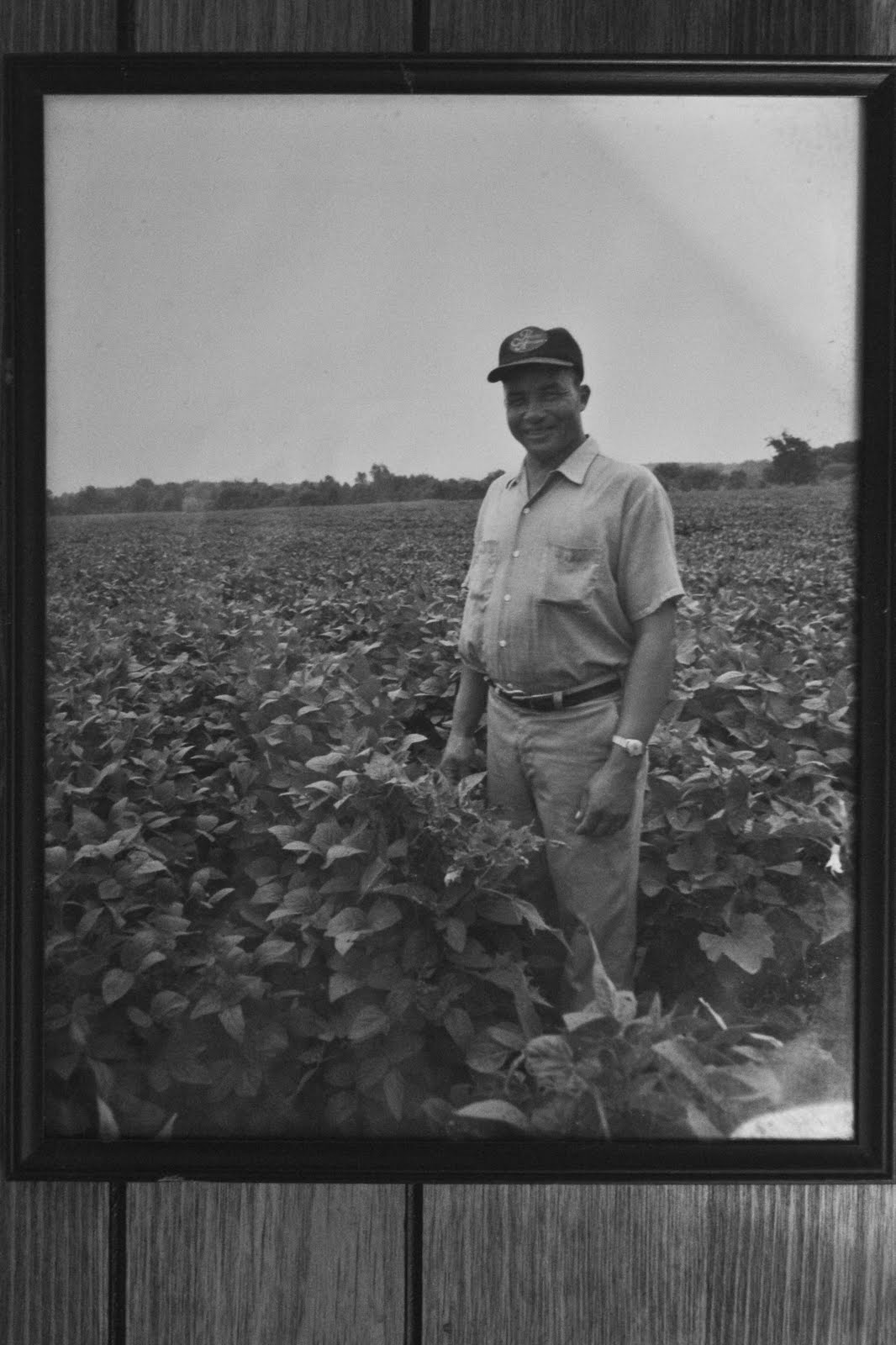
Just before we left Kentucky for Illinois we stopped in Owensboro to meet 83 year old soybean and tobacco farmer Harry Young. Mr. Young's story is vastly different from any other farmers we had met; he has a twisted tale of loss and racism, and his story seems unbelievable and definitely tragic. The story starts with the town he grew up in, which he describes as a place riddled with race discrimination and power struggles. There was the story about the white drunk driver who hit and killed a black child and got off with 30 days in jail, compared to the young black man who hit and destroyed a telephone pole and got 3 years in jail.


Harry said he has been a farmer since he was 4 and farming is in his blood. He had accumulated 289 acres that he farmed soybeans on until 2005 when everything changed. The government called in a loan that Harry said he already paid off and even had the receipt for, which he showed us. He has a copy of it blown up and posted on signboard in his front yard to advertise his unfair treatment at the hands of the government. The government insisted that Harry had an outstanding bill due and foreclosed on his property and assets.

Harry's brother was able to buy him a house, so he has at least something to his name, but all the farm equipment was confiscated and, according to Harry, undersold to friends of the local police and politicians. The legal battle to prove that he had paid his bill has been an ongoing nightmare for Harry, and his loss has been extreme. Signs decrying the local government adorn his front yard and inside his house the table tops and bookshelves are totally buried under stacks of papers, all legal documents. His wife left because "this has been trying," yet Harry continues to fight to get his farm back. Last year he spent 3 days sleeping on the floor of the local jail for making "terroristic threats" to a government official, and even though he was cleared for those charges at his trial he says he is still treated like a criminal. When we asked Harry if he ever thinks about leaving the area he looked at us incredulously and said "where would I go?"


There is an steadfast optimism to Harry despite the mess he has been through. He signs every letter (and he writes many letters to congressmen, senators, NAACP, the Obamas, etc, daily) with the phrase "God is forever good" and he recognizes that at least God and nature aren't prejudiced- his neighbor needs rain just as bad as he does.

There is another positive note to the story; while Harry does not have land of his own to farm anymore, he does farm his brothers 75 acres close to town. When asked what he would like to have happen in this situation Harry sighed and said that he would of course like to have his land back, but until then he would like people to tell his story so that maybe one day someone who can do something about the injustices will be listening, and be able to help. May it be so.


Red Boiling Springs, Tennessee: Jeff Poppen, Long Hungry Creek Farm


We heard of Jeff Poppen as "the Barefoot farmer" when we were in Asheville and were told that we should really try to meet this amazing man. We stepped onto his front porch and let ourselves in to find Jeff in the kitchen teaching his girlfriend's son to make pickles. Jeff's appearance is worth describing; he wears large round glasses and has long hair tied back in a ponytail with an equally long beard on his face that culminates in one massive dreadlock. Jeff seemed reluctant to talk at first and it felt like we were questioning him without much success until after a fine supper of corn, salad, and beets. An aside: at one point during the pickle making Jeff very adorably excused himself from the kitchen telling us "I'm going to go kiss my girlfriend."

So, while Jeff was very generous and hospitable, it didn't seem like we were getting too much information from him with his monosyllabic answers to our questions until he started talking about his compost and the quality of his soil. Like many of the farmers we have met, Jeff displayed his love for dirt by crouching down and lovingly picking up a handful, then crumbling it out through his fingers. His face looked radiant as he beamed up at us and told us that the dirt is what its all about; healthy soil equals healthy plants. When asked about issues in farming today Jeff replied that "there are no more farmers" because dumping chemicals on the ground doesn't count as farming.
What's your background? How'd you get into this?

I've been a farmer all my life.

In Chicago?

Near Chicago.

I'm guessing, but was it corn?

My dad had a horticulture operation; he was a nursery man. But it was in corn country.

And what do you do here? Seems like everything.

I've been running a small farm here since 1974.

Just produce?

It's a beef, a cow/calf operation. And gardens.

Do I understand it's a biodynamic focus?

I make biodynamic preparations and use them on my farm.

Is that something that your family did or something you got into yourself?

The latter.

Why do you choose to do it that way?

I don't use the calendar. I do it because it treats the soil as if it mattered and makes good quality vegetables. I like the way the vegetables taste.

So...is this a farming community?

Back in the old days it was. When I moved here. There is no farming in America anymore to speak of.

What do you mean by that?

Probably because I don't travel. I have a narrow definition of what farming is.

So what kind of changes would you like to see in the ag system to fit your definition?

There's only one thing that needs to happen in my opinon, mainly. And that is we have to return the cows to the farm.

You don't think people are doing that?

No. Most of our livestock are in confinement operations. And it's a way to concentrate wealth. Because when humans are allowed to live, they will have animals and crops in rotations on pieces of land. Agriculture is free. And there is no selling of produce. Produce has never been sold. And it shouldn't ever be sold. The fruits of agriculture are to be free, and this is the way it's always been. And wealth is relatively new. It wasn't uncommon a hundred years ago for people to inherit a lot of money and just say, "we don't want it." Why would you want a bunch of money? That just entails responsibilties...cause there's no place to spend it. It required...well, it was a lot of trouble. When food can't be sold, starvation ceases.

Do you see the importance of the cow on the farm as the nutrient cycling? Is that why you think it's important, to close your circles?

Well, the way I look at it, the dawn of civilization and the domestication of animals, arose hand in hand, and humanity can't live without ruminants. Mainly because a ruminant can live off a couple acres of land but make twice that much land per... So this necesitates every community having cattle and moving them around in such a way that fertility increases, and consequently there is a possibility of crop production, and then when crops are removed from the community, you're simply removing carbohydrates, staches, sugars, and proteins in a form that are basically carbon, hydrogen, oxygen, nitrogen, that all come free from the air and the water. And there's no expense whatsoever except nature and human labor. Other recent usurps of agriculture by the great pirates and the commodification of agriculture.

So how do you fit yourself in as a farmer? I'm assuming you have an income in some form through it.

Well, what I do is I have a farm budget of about a hundred grand a year and I have 200 families that are willing to give me 20 bucks a week for 25 weeks and they have all the vegetables that they need and I give everything else away and there's a sort of a free flow...I just load vegetables up every few months and send them down to Nashville and they take them home and have to give them to their neighbors and distribute them. It's a way of distributing food freely. And then, if at the end of the year I have money in the bank, then I do it again. People are pretty anxious to keep me in business.

You said you're a cow/calf operation. Are you selling your cows as well?

I sell a little bit of organic beef on the market. I believe that cattle are there just to inrease the fertility, not to make money.

There a lot more CSAs popping up all over the place. Do you think that's a good thing?

Yes.

How many acres are you working here?

The farm is 300 acres. I have about about a 100 ares of pasture and a couple hundred acres in forest, and maybe 8 acres of produce.

So you've been doing this how many years? 35?

Yeah.

So did you start with that same view on CSAs and cattle or has it changed?

No, I was a truck farmer most of the time. I started the CSA in 99 or 2000, somewhere around there, and it arose out through the biodynamic movement. And as insight of the different roles that farmers and nonfarmers play in a community. A farmer {?? with the forces of nature and PROduction. These forces of nature are dealt with in a way that requires a farmer's attention and intuition and spiritual insights. The rest, after the produce is cut, it's all a matter of REduction, and these are forces of humans taking the produce and distributing it, transportation...

So these forces are generally human forces and the farmer should have nothing to do with it. Whenever a farmer takes stuff to the market, they ruin the whole thing because there's all this produce there. And the farm should be looked upon as a self contained individuality, where everything that's needed for agricultural production comes from within the farm's borders, through the rotation of crops, and animals, and pastureland and this kind of stuff. When it's viewed that way, you can sort of see that the farm itself really just runs on itself and just excess carbon, all this free stuff leaves it; nothing changes. And that way you have "farming" because you're making something from nothing. And then you have wealth created in a given area. And this is the way civilizations have built up. And this is the way that...by destroying that you just destroy civilization. And this is what is happening right now.

So, if people are growing things, removing them from the farm and selling it elsewhere do you think it's possible to close loop some farms? Because even if the majority of it is carbon and things, there's all the other nutrients.

Well, it's impossible not to.

So do you think everybody should be farming then?

I think one person can farm enough for, I don't know, 50 or 100 people. Not all of them have to be a farmer.

You kind of told me what the role of the farmer is with the land...what do you think the role of the farmer is in society?

Well, the farmers are priests. And they're responsible for the incarnation of material.

And what kind of farming are other people doing (in this community)?

Nobody farms. There's no farming anymore. I don't call buying chemicals and Monsanto seed and throwing it out there and shipping feed to Texas feedlots, I don't call that faming. I think that's a blatant ripoff.

So how would you encourage more people to farm?

Blow two bridges up in St. Louis, I think would do it. I think to outlaw any corporation over 150 people. Close down all the WalMarts, that kind of stuff. Just have general depression.

Think that'll inspire more people to be more individualistic?

Well, you know, you can look at the model of Russia. 20 years ago we thought they were all gonna starve and the government said, "we're not gonna take care of you anymore," and they gave people land...and 90% of potatoes grown in Russia are never on the market, they're just grown in home gardens. If you don't sell food, people will grow it. They're not going to starve to death. They're smarter than that. And if they can't get chemicals, they'll figure out how to have animals and do it. So the way to encourage people to farm, the only way, is to get the animals out of the feedlots and back onto the land and then shut down the interstate system. And that, I assumed would have happened by 1975, 76, but is hasn't. That's why I don't prophesize much.

I like what you say, that people will know what to do, and they're smart enough...

Oh they're totally intuitive and everybody knows how to farm. It's just a generation or two back. Gotta get that soil humus; got to get that soil nice and fluffy, keep it healthy.

Are you happy with how things have worked out on this farm for you?

I'm generally a happy person.

Do you want to get any bigger?

I decided a few years ago that getting bigger was not what I needed to do; what I decided to do instead was to start other farms. Made no sense burning myself out and really there needs to be more farms. So I have a focus of raising farmers. I've taught a lot of people how to farm.

Do folks come and stay with you here and learn off this land or do you go stay with them and teach them there?

I do both, I mean I start farms when people pay me. I charge money, and then they take my tractors and make compost.

Those that you've started, do you think that people like and stick with the model that you set or do they want to get more commercial with it?

Um...I'm pretty outspoken about the noncommercialization of agriculture and it seems to be fairly popular with the people that I'm dealing with. I don't know, that may be just lucky. But there is a...it's foolish to try to make money in farming. Farming is for the lifestyle that allows a whole lot of people to live on the land as in a welfare system, where they don't really have to do anything. They can just lay around and smoke pot and drink beer and jump in the creek and meditate and read and, you know, play guitar, and just kind of hang out. I mean that's what farms are for. And most people need to do much anyway. And then every now and then the farmer rounds them all up and you plant a big field oryou harvest a big field; we don't need all those people most of the time. But the corporate model necessitates unemployment, poverty, starvation, and then a very extensive welfare system, prisons, and all that.

I know you say you don't prophesize, but can you see that happening, the shutting down of the corporate structure?

There are more prisoners today than there are farmers. Unbelievable. If you told me that when I was a kid, I would have just said, "no way." I have no idea what's going on.

What do you do for fun around here?

Farm.

How many head of cattle did you say you have?

I didn't say. There's about 50. Well, that's including calves. About half of that would be the correct answer, I suppose.

Are you able to manage that yourself?

I have two hired hands. And I have a lot of community support. Again, what I do is I come off of my hills with vegetables every day and I go through town, stop to get beer or whatever, and anybody, neighbors or friends from around here, is welcome to have anything off the truck that they please. Becasue I feel like it's my job to get money from the city to bring it in to Red Boiling. And then that makes me popular. And it makes it so that if I have any troubles I just go ask people and they're like, yeah, sure. And that's the way that communities work and farmers are always...sort of a typical way to run a farm. You don't try to make money, you just try to keep it going every year.


When Jeff was 19 he and his brother went in on Long Hungry Creek Farm together. He still is at it with his cow/calf operation and his vegetable CSA. He has several helpers who are around college age and Jeff likes to talk about the idealism of the farming lifestyle. His helpers get to swim in the river and lay in the hammock and take care of the vegetables when they need it. It is a beautiful way to live a slow paced life in this case. Jeff often drives through the town of Red Boiling Springs giving away his vegetables out of the back of his truck because he thinks everyone should have good food even if they can't pay for it.

He practices biodynamic farming, based largely on Rudolph Steiner's classic writings. To Jeff, the presence of the cow on the farm is tantamount, as they complete the cycling of nutrients from soil to food to soil again. His 300-some acres are mostly wooded and pastures, with 1-acre patches of vegetables scattered about in fences.

He has very stong beliefs about the capitalistic systems in which we live.

We walked down the long rows of lettuce that were unfortunately flooded and unsalvagable to the potato/squash cave on the left. Jeff and a little girl who was visiting disappeared inside and came back out with arms full of yellow squash to load into her mom's truck. It feels like it's about 50 degrees inside the cave, perfect for root storage.


The barefoot farmer has at this point turned downright friendly and, as it was evening, he invited us to stay the night on the farm so we wouldn't have to navigate in the dark. It's a tempting offer with the fireflies flashing and the bubbling clear stream, but instead we take Jeff's picture and head on down the road with him calling out "peace and love!" after us.