Sunday, July 4, 2010

Morgantown, PA: Dr. Hubert Karreman, veterinarian


Dr. Hubert Karreman was our last stop of the day; we met him at a sweet old diner near Morgantown PA. Dr. Karreman is a large-animal veterinarian and has been practicing for many years, though he has slowed down recently due to some heart troubles. He seemed like a kind, no-nonsense, humorous guy, and he spoke with us about the changes he's seen since he's been in agriculture. "Doc" (as he was referred to by Daryl) advocates organic practices, and has limited his vet practice to organic animals only, or people who are transitioning their animals to organic.

He offered some interesting perspectives; it's always fascinating to chat with people who play a part in agriculture other than the farmers themselves. People like Dr. Karreman get to see numerous farms and understand how they work at a glance...while many farmers rarely visit operations other than their own and their neighbors.

Dr. Karreman recently completed a 5-year stint on the National Organic Standards Board (NOSB), a 15-member USDA team that creates the national standards that organic farmers need to meet in order to be certified. He has published a book entitled "Treating Dairy Cows Naturally", a farmer-friendly look at simple methods of bovine treatment that can save trouble, money, etc.

Living in Lancaster County gives him the chance to compare and contrast operations and cultural differences such as the Amish farms, organic farms, and conventional larger dairies around. His own bio can be seen on his business site: http://www.penndutchcowcare.org/pages/HJK_bio.html

Phoenixville, PA: Seven Stars Farm, David and Edie Griffiths and Mark Dunphy


The next stop with our farm guide extraordinaire Daryl was Seven Star Farm, one of the first biodynamic dairies in the country. Seven Star Dairy sits on 300-some acres of land owned and put into a land trust by the local Waldorf school, which emphasizes farming and other practical skill building. There is a CSA on the property, but we spoke with the farmers who founded and operated the Dairy, David and Edie. David was injured by a falling round bale of hay some years ago, and Mark came on full time to oversee the machinery and manage the Dairy.

David studied at the University of California and cited Alan Chadwick as an inspiration, whose work remains preserved and modeled at UC-Santa Cruz to this day. David spoke quietly in his home about the way that Seven Stars has developed and the importance of a biodynamic system, as it allows attention to the cycling of nutrients on and around the farms. Edie was a happy and energetic woman, obviously in tune with the entire operation of the farm.

About 10 years ago, Mark joined the team to take on some of the farm management; we interviewed him as we toured the farm. He was obviously proud of the cows, the barn, and the entire system that they have polished over the years. He seemed to enjoy the challenges of being a dairy with self-imposed limitations and guidelines that come with the biodynamic focus.

The farm produces delicious yogurt and quarts of cream from beautiful brown faced Jersey cows. The maple syrup for the maple flavored yogurt comes from Canada in 50 gallon drums at $2,500 per barrel. Seven Star Dairy is committed to quality at whatever cost and Trav and I can attest to the deliciousness of the maple yogurt; we were given a quart along with a quart of cream, and the yogurt was divine. Seven Stars also emphasizes education, and they partner with the Waldorf School to teach agriculture to all comers.

We made strawberry ice cream with the cream, hand cranked at the house of our friends the next day. It was also really really good. Of course.

Honey Brook, PA: Elmer Kauffman


Being a friend of Daryl's has many wonderful benefits. When I told him the nature of this project he offered a helping hand right away. Being very involved in the farming community around Ephrata, Morgantown, and Terre Hill, Daryl offered to connect us to a few local farmers doing different things. Not only did he connect us, he chauffered us to three places all day on Friday, escalating him from awesome-person status to hero status in my book.

The first appointment was with Elmer Kauffman, an Amish dairy farmer whom Daryl has hauled cattle for. Without Daryl's help we never would have been able to speak with Elmer, so many many more thanks to Daryl for his support and involvement in our project.

Upon arriving at Elmer's we followed him into his home, which had beautifully polished dark wood floors and homemade quilts over the backs of chairs. We grabbed some folding chairs and followed Elmer out to the barn to hear about what he does. Elmer is a youthful looking 29 year old with a few kids and about 80 cows that he and his father milk. Elmer's hand was swathed in a thick gauze bandage with burdock from a recent injury involving a round baler.

He talked about how supportive the Amish community has been in light of his injury; when he had to go to the hospital and then was out of commission he found his farm was run by his neighbors who pulled together and cared for his animals and his fields. Elmer is a conventional farmer and said he has noticed in recent years that his crops have had much higher yields, which he suspects is due to chemical engineering to the seeds. Elmer does his field work with several HUGE mules (he was featured with them in a calendar with a mule theme which we can verify because he gave us a copy!).

Elmer said that he wishes someone would think of more streamlined technology for milking parlors. He, like many conventional dairy farmers that we've spoken to, has issues with the milk pricing system in the US. It's a very complex system that nearly nobody really understands. It has created financial issues in dairy operations all over the country with historically low commodity milk prices these past couple of years. Elmer was extremely generous to spend time with us, and while he declined to be photographed due to the Amish faith's aversion to graven images/pride, we did get a sweet shot of his gargantuan mules.

Terre Hill, PA: Doorstep Dairy, Daryl and Karen Wenger Mast


After our interview with the Garbers (at Spring Hill Dairy), Trav and I felt like we traveled back in time (remember the milkman?) when we interviewed my dear friends, Daryl and Karen about their new business, Doorstep Dairy.

This amazing venture was dreamed up by Daryl, whose grandfather was a milkman back in the day. When asked to describe this new business Daryl will smile and ask "Well, do you remember the milkman?" Daryl is offering a unique and incredible food service; he has selected local products from dairies and is using an online ordering systrem. His customers can pick out items they'd like to receive weekly, and every Friday Daryl will bring their picks right to the doorstep. Daryl said it was hard to pick the products he's offering because there are so many incredible farmers in the area with tasty products, and if all goes well he may expand his options in the future. There is an assortment of milk, cheese, baked goods, and yogurt (Trav and I tried the strawberry yogurt when we had lunch with Karen and Daryl...it was so good it knocked my socks off).

As the housing developments from surrounding cities get closer and closer to rural areas, Daryl sees it as an increasingly feasible option to begin offering a doorstep service.

Farming is a huge part of Daryl's life. He grew up on and operated a dairy farm, then sold his portion of that and started a livestock-hauling business. Through that network Daryl knows many farmers and families in the community, and is obviously well-liked and respected by all for his easy going and gentle manner and his great sense of humor. Daryl still hauls cattle and will continue to do so while Doorstep Dairy grows. I have no doubt that if Trav and I lived around Ephrata we would be customers of Doorstep Dairy; the products are incredibly delicious and local, building the local economy, and Karen and Daryl and family are so kind.

Kutztown, PA: Rodale Institute, Jeff Moyer


There is a certain amount of impulsivity destined to occur on a roadtrip like this. Trav does his best to plan out our route and call farmers and extension agents ahead of time, but every so often we stumble upon an amazing opportunity by way of a road sign. This was the case as we meandered down the Pennsylvania highway toward Lancaster and passed a sign for the Rodale Institute, a well known and highly respected educational/agricultural/technological center.

Trav's defensive driving skills had us whipped around in no time and we wound our way down some back roads to Rodale. We made an appointment to talk with Jeff Moyer, who has been the farm manager since the 1970's, and he took us on an amazing tour of the farm. We learned that the Rodale Institute is a non-profit that has been extremely influential in researching organic methods of farming in a scientific and practical way, and sharing their research findings with the public. J.I. Rodale bought the property in the 1930's because of an interest in the connection between healthy farming practices, healthy soil, and healthy people. Before anyone else really thought about organic farming, especially on a commercial production scale, Rodale saw a connection between what people ingest and how their health is affected. One of the goals of the farm today is to show anyone (long-time farmers, newcomer farmers, gardeners, grandmas, urban farmers, me) that it is just as economically, environmentally, and fundamentally viable to practice organic/sustainable farming as conventional farming.

To practically demonstrate this, Jeff will plant the same crop side by side and treat on conventionally and one organically, then measure how they do. The Institute finds that the organic plots produce as much, and in some cases, more than the conventional plots. Jeff said that a lot of farmers come to the Institute doubting that organic is a profitable way to farm, but they often leave with new ideas about how they can transform their operation to be profitable and sustainable. One thing Jeff mentioned that has really stuck with me is the fact that as consumers, each one of us has so much power. If we want a tomato that tastes like a tomato, then we may either have to grow it ourselves, or pay a local farmer to grow us a real tomato. Our other option is a cheap tomato, a tomato from thousands of miles away that was bred with genes to withstand a 20 mile an hour impact on plywood because it will need those genes to survive its insanely long ride to our grocery store.

The Rodale Institute offers all kinds of workshops covering topics like cover crops, no till farming, organic pest management and how to customize your plot to your needs and space. The Institute provides information and visual aids, and seeing profitable, organic, life affirming farming is worth a trip out there.

Interestingly, Jeff, who has been with the Institute since the '70's, created the no-till crimper for commercial-scale use. The crimper is basically a roller that attaches to a tractor and breaks the stems of a cover crop, such as rye. No-till systems can be applied to organic and conventional crops, reducing the amount of off-farm inputs needed to amend soil and increasing organic matter in a plot.

Monday, June 7, 2010

New Britain, CT: Urban Oaks Farm


The other site I (Kacy) visited in between hanging out with my important people was in New Britain CT, and it was an urban garden on a pretty large scale.  Trav and I parked in the parking lot of the store that abutted the garden and sold a lot of it's goods.  On the wall were numerous newspaper articles featuring Mike and Tony (who has recently passed away), partners with a passion for the land.  New Britain is somewhat of a rough city, there is a lot of crime there and it is a heavily populated city that is also pretty economically poor.   Mike told us that the lot he now uses as a garden had had 16 greenhouses full of flowers previously, but had long since been abandoned and used as a dump by the city residents.  Mike said there were bullet holes in the greenhouses when he first got there.  He got a grant from the state to clean the site up, and he got to work hauling trashed cars, old greenhouses, construction materials and everyday garbage off the land.  He was able to save several greenhouses from the flower business to use in his food production, and he's been planting ever since.

You are greeted with a phenomenal sight upon walking into the greenhouses; they are a marvel of artistry in there.  There are a few straight rows, but mostly the shrubs, plants and trees just flow in a beautiful design that seems more natural than manmade.  Mike has a fig tree as well as citrus trees, and rosemary shrubs that are huge.  There are rabbit hutches out back that house about 10 rabbits who are living a peacefully retired lifestyle, though their poop comes in handy as fertilizer.

Lancaster Pennsylvania: Spring Hill Dairy, Shirley and Dave Garber.


Lancaster was our destination after New York, a region rich with farms and Mennonites and Amish and Mennonite/Amish farmers. It is also home to my best friend from college, Miss Monica Neufeld (Spory). I could write a whole blog on her supreme greatness, the cuteness of her baby daughter, and her husband Chad's humor and hospitality. We were welcomed into the Neufeld palace and I stayed up way later than I can function at full capacity just to hang out with my old friend. Between ice cream and coffee and walks and delicious home-cooked dinners we caught up on the past 2 years and I still can't believe how blessed I am to be friends with people of such a high caliber. So...

Monica connected us to a really interesting and unique operation- it was a dairy farm run by computers and robotic machinery (with help from the Garber family). Spring Lawn Farm is Dave and Shirley Garber's place right outside of Lancaster City. The dairy has been in Dave's family for 6 generations, and is run by Dave, his brother, and his nephew. They use their unique farm as an educational tool in the community; there are charts to look at, a powerpoint (we didn't view that presentation as we had the real live tour), and computer screens hooked up to the milking machine that showed which cow was being milked, how often that cow is milked per day and how much milk the cow gives.

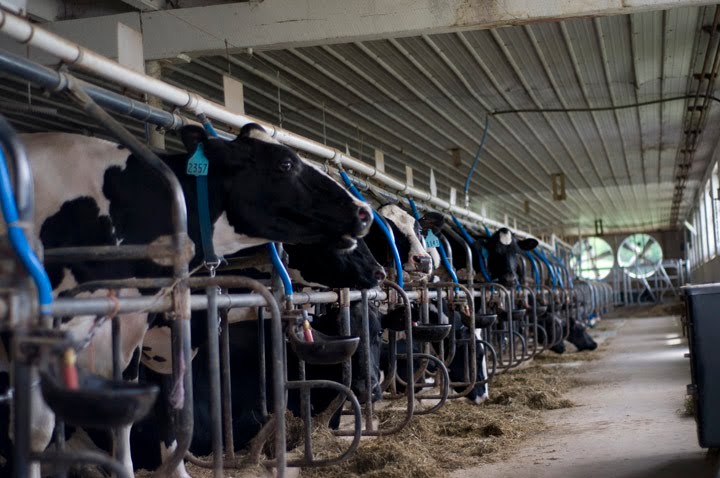
The way this farm worked is that the milking cows are kept in a barn where an automatic tiny plow constantly moves up and down the aisles where the cows' manure, keeping things really clean. These cows appear to have a lot of creature comforts that I have not yet seen in a barn. For example, if you've ever been to an automatic car wash you have seen those muppety looking things at the end that buff your car; they look like strips of foam on a whirling stick, one on each side of the car. The cows at Spring Lawn have a similar looking toy, it hangs from a pole in the aisle, and it sits idle until a cow comes into contact with it- then it's off spinning it's heart out providing the cow with a back/shoulder/face/behind scratcher and loads of entertainment.

Each cow decides when it's time for them to be milked, of their own volition. They line up at the milking parlor. A gate opens and ushers them in one at a time and then closes behind them. They must pass through this milking area to find their way to their food. From where we were standing we were eye level with the cow's udder, and we watched an infrared laser focus on each teat one at a time, then in one or maybe two tries a teat shaped tube would vacuum onto each teat and disinfect it. Then that scenario would repeat, but this time the tube would milk the cow, and the numbers on the computer screen would start changing to reflect the cow's stats, via an electronic collar that each one wears. If a cow doesn't show up for awhile to be milked Dave can see that via the computer, and his dad will find that cow in the barn and see what the trouble is. If the system fails for some reason, the computer will call Dave's phone to tell him there is a problem. It is a very systematic way to run a dairy.

One concern that the the Garbers have is the huge cost of mechanizing and computerizing their dairy. The price of milk fluctuates wildly in the U.S. and is set monthly by the federal government based on supply and demand. Since 2002 it seems like there have been extreme valleys and peaks in milk prices, and currently the price of milk is pretty low for dairy farmers. Dave and Shirley have no control over how much they can sell their milk for, and the threat of losing their multi generational farm is a constantly looming cloud on the horizon.

Despite worries and concerns that seem inherent to farming, the Garbers were the happy kind of people you just want to surround yourself with. As we walked down to where the pregnant cows are kept we got to see a cow just minutes old! Dave scrubbed it with hay and noted with some disappointment that it was a bull, but even so, what an event to witness.

Brooklyn, Connecticut: Katie Bogert at the Golden Lamb Buttery


"In 2000, my mom married Jim, my stepdad, which is the Booth son. I was a senior in high school. We just lived in the next town over and I was working here before that. My mom waitressed here before I did. I started at 13 as a coat girl."

Italic "My grandparents, they're both 87. They're currently in a nursing home, but my grandmother Jimmie, she cooked for 42 of the 47 years, so really till they were 83 or 84 they were running it. Then there's my stepdad, and then there's only one other son, and he helps where he can, but the rest of the extended family, no one lives around here. And actually, in three weeks...we have a family reunion every five years...so we have about 60 people coming in from all around the country: California, Seattle, Montana, and then like North Carolina, Atlanta, everywhere."

I took a break from doing the project while we were in Connecticut so that I could soak up being with my family, and I am so grateful I had that time. I ended up being part of 2 of the interviews and my mom actually accompanied us to one of them, the Golden Lamb Buttery, a restaurant in Brooklyn, CT.

She had first taken us there at Christmastime when we visited, and it is in what Connecticut refers to as the "quiet corner"- the northwest section that consists of a lot of farmland and countryside. My mom and her partner Rena were considering having their union ceremony at the Golden Lamb, but thought that too many of their friends wouldn't be able to make the trip out there as it is far off the beaten path.

We spoke to Katie Bogert, who let us know that people do actually travel for many miles to get to the Golden Lamb. It was her grandfather, a gentleman farmer, who bought the property in the '40's and kept sheep there. On the property there was a weaver and a clothing shop that took the wool and made very fashionable suits for men and dresses for ladies. Katie showed us a photograph album that had plenty of pictures of her grandmother, Jimmie, looking like a model in fantastic dresses and matching hats.

"The farm has been in the family since...it was Bob's father who bought it in the early 40's and years ago they sold the development rights to the government, so if the family were to ever sell the farm it would always remain a farm; it couldn't be a golf course or condominiums or a development. Right now there's about 1000 acres left. When he first bought it it was about 1800."

"Well, Hill and Dale Handweavers closed in the 70's when wool went out and synthetics came in...financial reasons...no one in the family wanting to do it. And even though we've always had cattle and sheep it has always been more of a gentleman's farm than a real, true 1000-acre working farm. So, my great grandfather, when he bought it he lived in the city and wanted something out here, found it, fell in love with it, found out it was in 'Brooklyn' and didn't want to go back and tell his Manhattan buddies he bought a farm in Brooklyn, so he bought 50 adjacent acres in Pomfret and the restaurant had a PO Box in Pomfret for years so we could say we were from Pomfret, not Brooklyn."

It is no longer an actively farmed property, other than haying on some of the main fields. The restaurant, with its dinners and events, is the attraction. They started serving meals in 1963.

The Buttery still has some animals. Out in back there are rolling pastures where 5 donkeys who were somewhat rescued graze and frolic. There are cows as well,though not for production. There are still some sheep, but they are ornamental and the dress/suit shop is long since gone. Katie lives in the old weavers' building.

"So, Hill and Dale Handweavers...men and women were coming from all over to get these suitjackets and suits made; they were custom, no two were the same. In that time it was growing in popularity but there was nowhere for them to eat. So they opened, just light lunches, very simple, in '63 and it was about 10 years later when dinners started and then it sort of evolved from there."

"At this point we just hay the fields; the major fields are hayed, and then the animals are just pets. We have 5 donkeys, you can see them, blending into the scenery over there. Of the donkeys, Boomer is pushing 40. So, we had Boomer and we had a Shetland pony, and then came Muffin; Muffin's the one who's walking away. She has the donkey body with the horse's face. Since Boomer's kind of getting up there I wanted to have someone for Muffin...there was an ad in the local paper, 'donkey family for sale.' I called and thought 'I can't believe I'm responding to this.' So we went and saw them and, long story short, a couple days later they were her. So now we have Bandit, Sassy, and Nestle."


Eventually the farm transitioned into an upscale restaurant, with most of the existing buildings used for that purpose. The barn is now the dining room and kitchen; you walk in the big double doors and down a hallway that has wooden benches and quilts hanging on the walls, as well as framed newspaper write-ups and family reunion pictures. Continue through the small kitchen to get to the seating in the main area of the barn where beautiful, rustic wooden tables and chairs (mismatched in traditional farm fashion) await you. The Buttery serves as much local food as possible, and the quality of ingredients as well as skill of the chef are highly valued there.

"We have our garden, greenhouse, raised beds across the street and that does the majority of our herbs and produce. And I buy local as much as I can, but we've never raised cows for...I mean, when we used to have sheep, people would be like, 'please tell me that's not my lamb!' So we don't raise the meat for here, it's more vegetables."

"Right now I can do vegetables, I can do herbs, but in terms of meats and everything...I can't get anything consistently. And it has to be consistent. So I would like to see more collaboration with farmers and restaurants. Somewhere where I can go and get these things and not need to talk to seventeen different farmers to get seventeen different things and drive to seventeen different places, because that kind of defeats the purpose. So I would like to see more collaboration.
"

"You want to be able to use local foods, but again, you've got to be able to get it easily and it's got to be consistent. And right now, around here, we just don't have that."


The Buttery is only open for lunch for 2ish hours from Tuesday to Thursday, and dinner is Thursday through Saturday, reservations are advised. The way it works is people pay a flat fee of 75 dollars per person and get an experience as well as dinner. The evening includes a hay ride, dinner and live music, and no tables are turned over so patrons are welcome to stay with no pressure to hurry along.

Sunday, June 6, 2010

Farmers' Market stop: Harrisonburg, Virginia


Well, we've made plenty of progress on the project; we've interviewed at least 35 people in less than a month and a half, a remarkable diversity of agriculturalists from Maine to Virginia. The hardest work is going to be transcribing all of this information!

The blog here thinks we're still back in Vermont. In fact, we've progressed the last few weeks and done interviews in Connecticut, New York, Pennsylvania, and Virginia! Tonight is our last evening in Virginia before we head west to West Virginia, down to North Carolina and then onward to Kentucky, Oklahoma, Kansas and points towards the Pacific.

Since we're so far behind on updating the blog (each entry takes a couple hours of photo editing, reviewing the audio and our notes, and typing), I thought I'd share some photos that I took at the Harrisonburg, Virginia farmers' market a few days ago. Kacy went to college in this town and has a friend who happens to be the president of the market.

Here are about 20 individuals of the several dozen involved in the Harrisonburg Market with their miscellaneous wares!

Thanks for reading! We'll do our best to keep you up to date...or at least less than a month behind us. Take care-- Trav--

Tom Hayman: Grains of Sense, locally roasted organic coffee, "divinely inspired."


Sherry Richardi.

Sharon Payne and her granddaughter, Briana Ford.

Rosalind Byler, pies and pastries.


Inger Brown and Rachel Wilson: homesteaders, keeping bees for some income.


Philip Hege: vegetables; he'd seen me taking photos of others and when I approached him he said, "You're shootin' people! I don't believe in that."


Matt Gingerich: produce.


Kate Nussbaum: lavender and related products.


Josie Showalter: market manager.


John Blalock.


Jenner Brunk.


Gayle Shirk: jams and confections.


Esther Ebey.


Derrick Cook and Dora Smith: homemade pasta; in Virginia kitchens don't need to be inspected as long as they are labeled as such. Consumers can choose to trust their producers.


Dennis Evans: cheese and dairy products, including "meow milk", a cultured product for cats.


Beth Schermerhorn: part of the Muddy Bikes project, an urban gardening organization that works with homeless and other populations. We interviewed them as well on their property; look for that post in the future!


Ann Marie Leonard: she has been involved with the market for over 20 years. She gave me two wonderful cookies as market closed.


Andrew Schaefer: produce and plants.


These are the people growing and creating your food, living in your community. They have a hand in the greater agricultural system of this country and deserve recognition; if only we could interview and photograph everybody!

Wednesday, June 2, 2010

Westminster, Vermont: Paul Harlow, Westminster Organics


The last farm we stopped at before leaving Vermont was Paul Harlow's in Westminster, near Putney in southern Vermont. May 7th was a beautiful sunny day and we were greeted by Paul's little mutt Speckles (or Especkles as we fondly dubbed her, being from Puerto Rico and all). He was meeting with his crew, largely made up of Jamaicans who have been returning seasonally for many years. He took an hour off to talk with us before heading out to transplant broccoli into his fields. Paul's farm is a large produce and vegetable operation with chickens (about 1000), beef, Tamworth pigs, and eggs for sale as well. It is one of the largest veggie operations in Vermont. He is 59.
Many thousands of baby kale plants:

The farm has been in the family for 3 generations (his grandfather purchased it in 1917) and Paul's son works with him as does his young daughter (she sells the eggs to the farm stand just down the road, run by Paul's brother and family). His sister lives nearby as well and is an agriculture writer. Paul decided to transition his farm to organic in 1976 after he noticed that he didn't see many worms anymore, and his weeds were getting resistant to herbicides. It was rough for a couple of years during the transition because he admittedly didn't know how to do it...and there weren't many models of any scale in the area at the time.


Contributing to the community is important to Paul; last year he gave 150,000 pounds of food to food pantries, and he donates his time, equipment, and expertise to a garden the size of a soccer field at his daughter's elementary school. Aesthetics are also important to Paul and the community- when talking about why he plants bright colored produce in the front of his farm closest to the road he said "I do it for the people driving up and down route 5...I figure they could use pretty colors and appreciate straight rows." He is a town selectman and has been involved with local functions and politics for longer than he'd like to admit. He battles with common misinterpretations of organic produce (like expense) and the school lunchlady (who doesn't use or want the produce that he offers for free to the school).


Micromanagement from the government is something Paul struggles with as a large produce farmer- in the upcoming organic standards updates there are regulations about not drinking coffee in your fields and not having cats in your barn etc; it seems invasive and impractical. Paul talked about the frustration it brings when someone who has possibly never set foot in a field is making up rules that the organic farmer must abide by to keep the organic certification, rules that may have no realistic value except on paper. In Paul's words, "I just want to grow stuff... f*** regulations and marketing."

He would like to see all of his produce sold locally, but as it is there isn't enough demand. He sells to wholesalers, Whole Foods Market, etc., but imagines an ideal world where he can be a farmer who provides for his regional community. His produce can be found down the road at the Putney Food Co-op, where his portrait hangs above the produce section, along with other suppliers to the store.

Down the road at Paul's brother's farmstand: